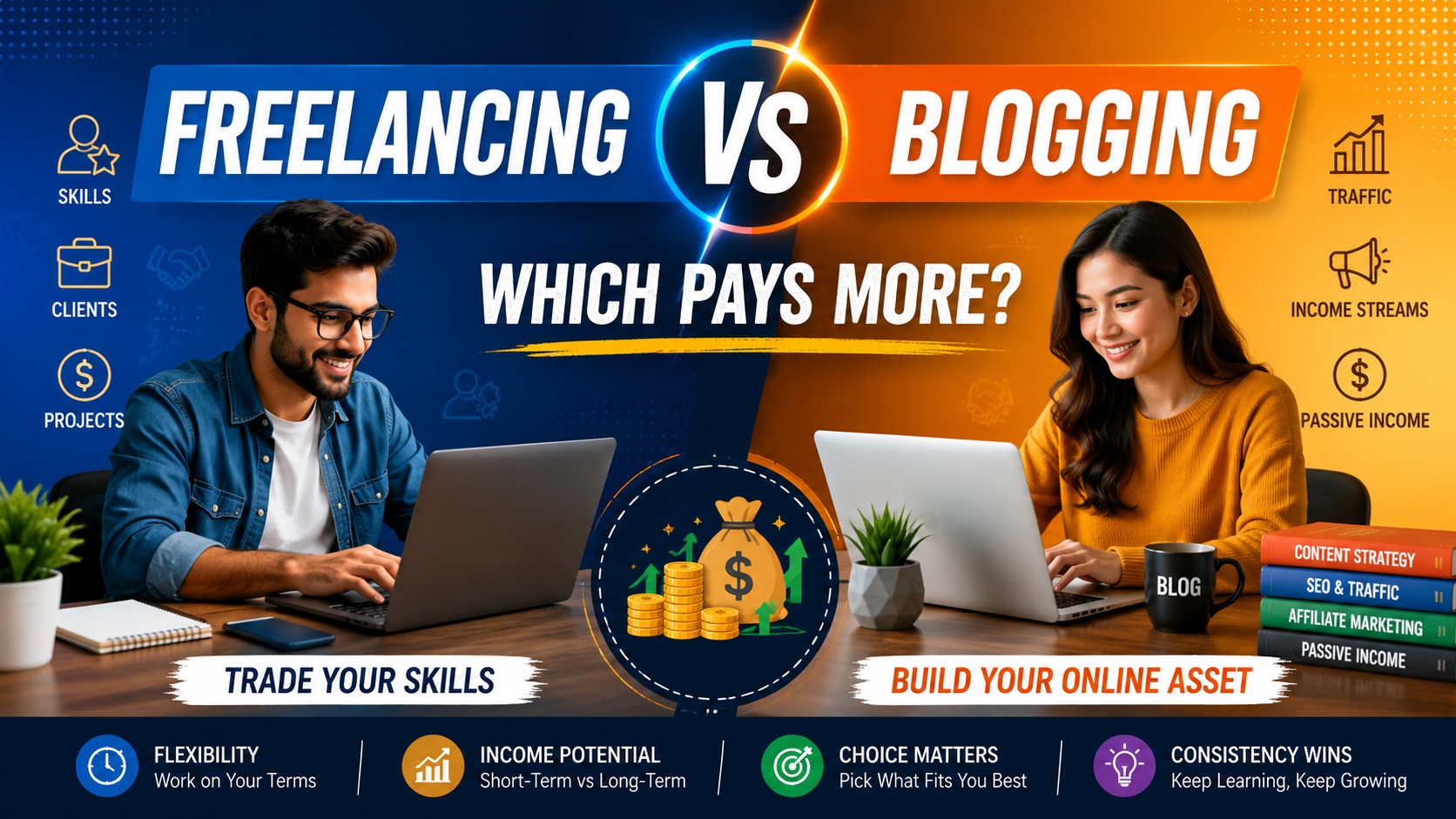
Freelancing and blogging are two popular ways to build an online income, but they work in very different ways.
Freelancing can generate money relatively quickly by selling your skills to clients, while blogging usually takes
longer to build but can create multiple income streams over time.
So, which pays more: freelancing or blogging? The answer depends on your skills, consistency,
niche, audience, and how you plan to monetize your online work. This guide compares both options to help you
choose the right path.
What Is Freelancing?
Freelancing means providing professional services to individuals or businesses without working as a permanent
employee. Freelancers can work on short-term projects, ongoing contracts, or individual assignments.
Popular freelance services include:
- Content writing and copywriting
- Website design and development
- Graphic design
- SEO and digital marketing
- Video editing
- Social media management
- Virtual assistance
- Programming and software development
What Is Blogging?
Blogging involves publishing useful and engaging content on a website around a specific topic or niche.
Instead of directly charging readers for every article, bloggers generally monetize their audience through
advertising, affiliate marketing, sponsored content, digital products, memberships, or their own services.
A successful blog can continue attracting visitors through search engines and other channels even when you are
not actively working on a client project.
Freelancing vs Blogging: Quick Comparison
| Factor |
Freelancing |
Blogging |
| Initial investment |
Low |
Low to moderate |
| Time to first income |
Usually faster |
Usually slower |
| Main income source |
Client projects |
Ads, affiliates, products, sponsorships and services |
| Income potential |
High |
High, especially after building traffic |
| Income scalability |
Limited by time unless you build a team |
Highly scalable |
| Job flexibility |
High |
Very high |
| Traffic required |
No |
Usually yes |
| Client dependency |
High |
Low |
| Long-term passive potential |
Lower |
Higher |
Which Can Make Money Faster?
Freelancing usually wins when it comes to earning money quickly. If you already have a
marketable skill, you can create a portfolio, approach potential clients, and start accepting paid projects.
For example, a skilled web designer may earn from a single website project, whereas a new blogger may need
months of consistent publishing and promotion before generating meaningful advertising or affiliate revenue.
However, your actual results will depend on your skill level, pricing, demand, ability to find clients, and
the quality of your work.
Which Has Higher Long-Term Income Potential?
Blogging can have greater long-term scalability. A freelancer generally earns when completing
work for a client. A blog, on the other hand, can attract thousands of visitors and generate revenue from
several sources simultaneously.
A blog can potentially earn through:
- Display advertising
- Affiliate marketing
- Sponsored articles
- Digital products and ebooks
- Online courses
- Memberships
- Lead generation
- Consulting and freelance services
The important difference is that blogging requires you to build an asset—your website, content library,
search visibility, email audience, and brand. That process can take considerable time.
Advantages of Freelancing
- Faster path to income: You can start earning as soon as you secure clients.
- Low startup cost: A computer, internet connection, and relevant skills may be enough to begin.
- Flexible working: You can often choose projects, clients, and working hours.
- Skill-based earning: Specialized skills can allow you to charge higher rates.
- Direct customer feedback: Working with clients helps you understand real business problems.
Disadvantages of Freelancing
- Income can fluctuate from month to month.
- You need to continuously find or retain clients.
- Working hours can increase as your workload grows.
- Difficult clients or scope changes can affect your time and earnings.
- Your earning capacity can be limited by the number of hours you can work.
Advantages of Blogging
- Multiple income streams: You can monetize the same audience in different ways.
- Scalable business model: A successful article can attract visitors repeatedly.
- Builds authority: Consistent useful content can establish expertise in your niche.
- Long-term asset: Your website and content library can continue creating opportunities.
- Business opportunities: A blog can generate leads for consulting, services, products, or partnerships.
Disadvantages of Blogging
- It can take a long time to build consistent traffic.
- Search engine rankings are not guaranteed.
- Creating quality content requires patience and consistency.
- Competition can be intense in popular niches.
- Advertising and affiliate earnings can vary with traffic and audience behavior.
Freelancing vs Blogging: Which Is Better for Beginners?
If your primary goal is earning your first online income as soon as possible, freelancing
may be the better starting point. Choose a skill you already understand, create a small portfolio, and
focus on finding your first few clients.
If your goal is to build a long-term online business, blogging may be more attractive.
You will need to invest time in keyword research, content creation, SEO, promotion, and audience building
before expecting substantial results.
Can You Combine Freelancing and Blogging?
Absolutely. In fact, combining both can be a powerful strategy.
You can use freelancing to generate income while developing a blog on the side. Your freelance experience
can provide real-world knowledge that you can turn into helpful articles, tutorials, case studies, and
guides.
For example, an SEO freelancer could create a blog about SEO. The blog can attract people searching for
SEO advice, while some visitors may eventually become consulting or freelance clients. This creates a
connection between content, traffic, authority, and services.
Which One Should You Choose?
There is no universal winner. Your choice should depend on your goals and strengths.
- Choose freelancing if you have a useful skill and want to focus on generating income sooner.
- Choose blogging if you enjoy writing, research, SEO, and building an audience over time.
- Choose both if you want immediate earning potential while building a scalable online asset.
Final Verdict: Freelancing vs Blogging
So, which pays more—freelancing or blogging? Freelancing generally has the advantage for
short-term income because you can directly exchange your skills for money. Blogging usually takes longer,
but it has stronger potential for creating scalable income through traffic, affiliates, advertising, products,
and services.
For many beginners, the smartest approach is not to choose only one. Start freelancing to develop your income
and experience, while building a blog gradually. Over time, your blog can become a valuable source of traffic,
leads, and additional revenue.
The key is consistency. Whether you choose freelancing, blogging, or both, long-term success
comes from developing valuable skills, providing useful content, understanding your audience, and continuously
improving your strategy.