
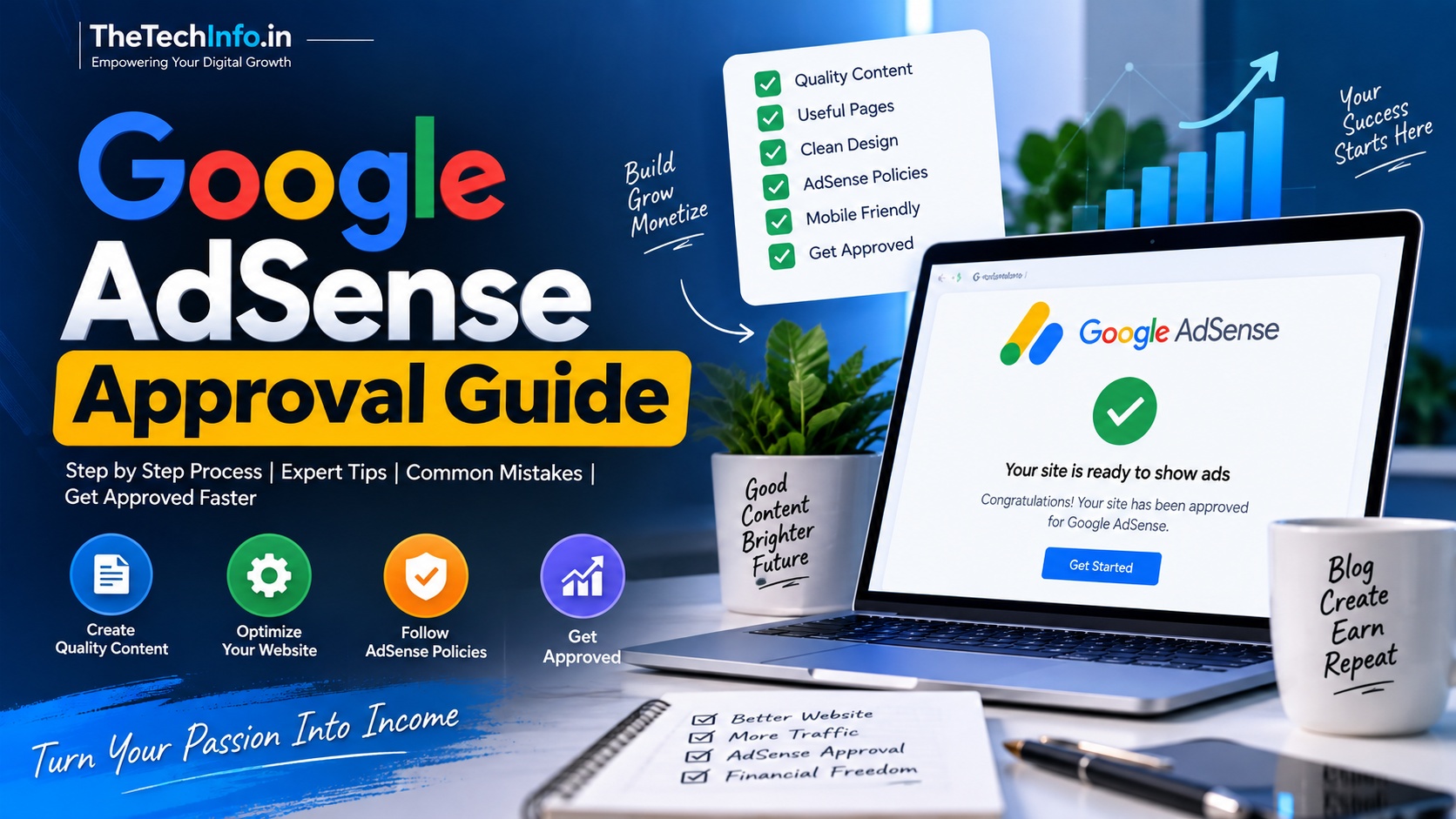











Google AdSense Approval Guide banner illustrating website monetization, AdSense approval, online advertising, analytics, and earnings for bloggers and website owners.

Google AdSense Approval Guide

Getting approved for Google AdSense is an important milestone for bloggers and website owners who want to monetize their content. However, approval is not simply about submitting an application. Google evaluates your website, content quality, user experience, navigation, and compliance with its policies. This Google AdSense Approval Guide explains the essential steps you should take before applying, common reasons applications are rejected, and practical ways to build a website that is ready for AdSense.

What Is Google AdSense?

Google AdSense is an advertising program that allows website owners to display relevant advertisements on their websites and earn revenue when visitors interact with eligible ads. The amount you can earn depends on factors such as traffic, audience location, content topic, advertiser demand, and ad engagement. For beginners, AdSense can be a simple way to start monetizing a blog without directly finding individual advertisers. However, your website must follow Google’s policies and provide genuine value to visitors.

How Does Google AdSense Approval Work?

After you submit your website for AdSense, Google reviews it to determine whether it meets the program’s requirements and publisher policies. The review can consider your website’s content, navigation, originality, user experience, and overall quality. Approval is not guaranteed simply because a website has a certain number of articles or visitors. A smaller website with useful, original, well-organized content can be better prepared than a larger website filled with low-value or copied material.

Google AdSense Approval Requirements

Before applying, make sure your website is professionally prepared and follows Google’s policies. The following checklist can help:
  • Publish useful and original content.
  • Provide clear and easy-to-use website navigation.
  • Create important pages such as About Us, Contact Us, and Privacy Policy.
  • Use a mobile-friendly and responsive design.
  • Make sure your website loads properly on different devices.
  • Avoid copied, automatically generated, or low-value content.
  • Do not publish content that violates Google’s publisher policies.
  • Use a professional domain and website structure.
  • Make sure important pages and articles are accessible to visitors.
  • Remove broken links, unfinished pages, and unnecessary placeholder content.

1. Create High-Quality Original Content

Content is one of the most important parts of an AdSense-ready website. Your articles should provide useful information, answer specific questions, and offer something valuable to readers. Avoid copying articles from other websites or rewriting existing content without adding meaningful value. Instead, create content based on your own research, experience, explanations, examples, and insights. For a new blog, focus on building a useful collection of well-written articles around a clear topic rather than publishing a large number of short articles simply to apply for AdSense.

2. Build a Clear Website Structure

Visitors should be able to understand your website quickly. Organize your articles into relevant categories and provide a simple navigation menu. A good website structure can include:
  • Home
  • Blog
  • Categories
  • About Us
  • Contact Us
  • Privacy Policy
  • Terms and Conditions
Use descriptive category names and avoid creating unnecessary categories with only one or two articles.

3. Create an About Us Page

An About Us page helps visitors understand who operates the website and what the website is about. Explain your website’s purpose, the topics you cover, and how your content helps readers. Keep the page genuine and relevant to your website. Avoid making unsupported claims or presenting misleading information about your experience or expertise.

4. Add a Contact Us Page

A Contact Us page gives visitors a way to communicate with you. You can provide a contact form, business email address, or another appropriate communication method. Make sure the contact method works correctly before submitting your AdSense application.

5. Publish a Privacy Policy

A privacy policy explains how your website handles visitor information and technologies such as cookies. A website that uses advertising, analytics, contact forms, or other third-party services should clearly explain relevant data practices. Your privacy policy should accurately reflect how your website operates. Do not simply copy another website’s policy without reviewing and adapting it to your actual practices.

6. Improve Website Navigation

Good navigation makes it easier for visitors to find your content. Keep your primary menu simple and organize related articles into logical categories. Check your website for:
  • Broken navigation links
  • Missing pages
  • Dead-end pages
  • Confusing menus
  • Excessive pop-ups
  • Unreadable text
  • Pages that do not work properly on mobile devices

7. Make Your Website Mobile-Friendly

A large percentage of web traffic comes from smartphones and tablets. Your website should provide a comfortable experience across different screen sizes. Check that your text is readable, buttons are easy to tap, images fit within the screen, menus work correctly, and visitors do not need to zoom or scroll horizontally.

8. Improve Website Speed

Website performance affects user experience. A slow website can make visitors leave before reading your content. To improve performance, consider compressing images, removing unnecessary plugins, using an efficient theme, reducing unnecessary scripts, and enabling appropriate caching and optimization features.

9. Use a Professional Domain

A professional website address can help establish a clear online identity. If you are building a long-term blog or business website, using your own domain is generally preferable to relying entirely on a temporary or incomplete website address. Before applying, make sure your domain works correctly with HTTPS and that both visitors and search engines can access your important pages.

10. Avoid Copyright Infringement

Do not publish copyrighted images, videos, articles, music, or other material unless you have the necessary rights or permission to use them. When using images, choose content that you are legally permitted to use. Keep records of licenses or permissions when appropriate.

11. Avoid Low-Value Content

Publishing many pages does not automatically improve your chances of approval. Articles should be useful, readable, and created for people rather than simply designed to attract search traffic. Examples of content that may provide little value include extremely short articles with no useful information, duplicated pages, automatically generated pages without meaningful human value, and content created primarily to manipulate search rankings.

12. Check Your Website for Policy Issues

Before applying, review your website carefully for content or activities that may violate Google’s publisher policies. Pay particular attention to pages involving prohibited or restricted content, misleading claims, copyright violations, deceptive practices, invalid traffic, or other policy concerns.

How Many Articles Do You Need for AdSense?

There is no universal article count that guarantees AdSense approval. Instead of focusing on a specific number, concentrate on publishing a useful collection of original articles that demonstrates the purpose and value of your website. For a new website, it is generally better to have several well-developed articles covering your main topics than dozens of thin pages created only to increase the article count.

Do You Need Traffic for AdSense Approval?

A website does not need to have massive traffic before applying. However, having a real audience can be useful for building a sustainable website business. Do not purchase traffic, click your own advertisements, encourage visitors to click ads, or use other methods intended to artificially increase advertising activity. Such practices can create serious policy problems.

How to Apply for Google AdSense

  1. Create or sign in to your Google account.
  2. Visit the official Google AdSense website.
  3. Start the AdSense signup process.
  4. Provide your website and required account information.
  5. Follow the instructions to connect your website with AdSense.
  6. Review your information carefully before submitting the application.
  7. Wait for Google to review your website.
Make sure your website is ready before submitting the application. Fixing important issues first can make the process easier and prevent avoidable problems.

Common Reasons for AdSense Rejection

AdSense applications can be rejected for different reasons. Some common problems include:
  • Insufficient or low-value content
  • Copied or duplicated content
  • Poor website navigation
  • Incomplete website pages
  • Policy violations
  • Copyright-related problems
  • Poor user experience
  • Misleading or deceptive content
  • Website technical problems
  • Invalid or suspicious traffic activity

What to Do If AdSense Rejects Your Website

Do not panic if your first application is rejected. Read the reason provided by Google carefully and identify the areas that need improvement. Review your articles, navigation, website design, important policy pages, technical performance, and overall user experience. Make meaningful improvements instead of making superficial changes. Once your website is properly improved, you can follow Google’s instructions for requesting another review or reapplying where permitted.

AdSense Approval Checklist

Checklist Item Status to Check
Original Content Useful and unique articles published
About Us Page published and accessible
Contact Us Working contact method available
Privacy Policy Published and accurate
Navigation Simple and easy to use
Mobile Design Responsive on smartphones and tablets
Website Speed Pages load efficiently
HTTPS Website uses a secure connection
Copyright No unauthorized copyrighted material
Policy Compliance Website follows applicable Google policies
Broken Links Important links tested and working
Traffic Quality No artificial or invalid traffic activity

Tips to Improve Your Chances of AdSense Approval

  • Write primarily for your readers, not only for search engines.
  • Develop a clear topic and purpose for your website.
  • Publish comprehensive articles that genuinely answer user questions.
  • Use headings, short paragraphs, lists, and images where they improve readability.
  • Maintain consistent website navigation.
  • Remove thin, duplicated, or unnecessary pages.
  • Check every important page on mobile and desktop.
  • Use legally obtained images and other media.
  • Keep your website information accurate and up to date.
  • Never click your own ads or encourage others to click them.

Frequently Asked Questions

Is Google AdSense free?

Yes. There is generally no fee to submit an AdSense application. However, you are responsible for the normal costs of running your website, such as domain registration, hosting, and optional tools or services.

Can a new blog get AdSense approval?

Yes, a new blog can apply if it meets the applicable requirements and policies. The age of a website alone does not guarantee approval.

How long does AdSense approval take?

Review times can vary. Google may take different amounts of time depending on the website and review process. Follow the status shown in your AdSense account for the latest information.

Can I use AI to write blog content and get AdSense approval?

Using AI tools does not by itself guarantee or prevent approval. What matters is whether the resulting content provides genuine value, is useful and original, and complies with applicable Google policies. Do not publish large amounts of unedited, repetitive, or low-value AI-generated content simply to increase page count.

Can I apply for AdSense without a privacy policy?

A privacy policy is an important part of a professionally prepared website, particularly when your website uses advertising, analytics, cookies, or other services that process visitor information. Make sure your privacy information accurately describes your site’s actual practices.

Does having a lot of traffic guarantee AdSense approval?

No. Traffic alone does not guarantee approval. A website must meet Google’s applicable requirements and policies, and traffic should come from legitimate sources.

Final Thoughts

Getting Google AdSense approval should be treated as part of building a trustworthy and useful website, rather than as a simple application process. Focus on original content, strong navigation, a good user experience, essential website information, technical quality, and policy compliance. Once your website is properly prepared, submit your AdSense application and continue improving your content and audience experience. Even after approval, maintaining policy compliance is essential for long-term monetization. Remember: There is no guaranteed formula for AdSense approval. The best strategy is to build a genuine website that provides clear value to its visitors and consistently follows Google’s applicable policies.

Latest Tech Insights & Expert Guides

Google AdSense Approval Guide
14Sep

Google AdSense Approval Guide

Google AdSense Approval Guide Google AdSense Approval Guide Getting approved for Google AdSense is an important milestone for bloggers and website owners who want to monetize their content. However, approval…
Technical SEO Guide
03Sep

Technical SEO Guide

Technical SEO Guide Technical SEO Guide Technical SEO plays a major role in how easily search engines can discover, crawl, understand, and index your website.Even excellent content may struggle to…
On-Page SEO Checklist
02Sep

On-Page SEO Checklist

On-Page SEO Checklist On-Page SEO Checklist On-page SEO is one of the most important parts of improving your website’s visibility in search engines. Even if you publish excellent content, your…

Leave a Reply

Your email address will not be published. Required fields are marked *