Getting your website to rank higher on Google is not about finding a secret trick or stuffing pages with keywords. Modern SEO is about creating genuinely useful content, building a technically sound website, and making it easy for both visitors and search engines to understand what your pages are about.
Whether you run a blog, business website, affiliate site, online store, or WordPress website, improving SEO can help you attract more organic visitors without paying for every click. The challenge is knowing which SEO activities actually deserve your time.
In this guide, you’ll discover 25 practical SEO tips that can help improve your website’s visibility, user experience, and ability to compete in Google Search.
What Is SEO and Why Does It Matter?
SEO stands for Search Engine Optimization. It is the process of improving a website so that search engines can better discover, understand, index, and present its pages for relevant searches.
For example, if you publish an article about speeding up a WordPress website, good SEO can help Google understand the topic of your page and determine when it may be useful to someone searching for information about WordPress performance.
SEO matters because organic search can provide a steady source of relevant traffic. Unlike advertising, you do not pay Google every time someone clicks an organic search result. However, strong rankings are never guaranteed. They usually require useful content, good technical foundations, a positive page experience, and continued improvement.
25 Proven SEO Tips to Improve Your Google Rankings
1. Understand Search Intent Before Choosing a Keyword
One of the biggest SEO mistakes is choosing a keyword simply because it receives searches. Before creating a page, understand why people are searching for that phrase.
A person searching for “how to start a WordPress blog” probably wants a tutorial, while someone searching for “best WordPress hosting” is more likely comparing services. These searches require different types of content.
Look at the pages already appearing for your target query. Pay attention to whether Google is showing tutorials, product pages, comparison articles, videos, category pages, or another content format. This can help you understand what users are likely trying to accomplish.
2. Target One Clear Primary Topic
Every important page should have a clearly defined primary topic. Trying to optimize one article for many unrelated keywords can make the page confusing for both readers and search engines.
Choose one central search topic and naturally cover closely related questions and subtopics around it. This creates a more complete resource without forcing unnecessary keywords into the content.
3. Use Long-Tail Keywords
Broad keywords can be extremely competitive. Long-tail keywords are usually more specific and can reveal exactly what the searcher needs.
Instead of targeting only a broad phrase such as “SEO tips”, you could create content around more specific searches such as “SEO tips for a new WordPress blog” or “how to improve SEO for a small business website.”
Long-tail queries may individually attract fewer searches, but they can bring highly relevant visitors to your website.
4. Create Content for People First
Write for your audience, not for an algorithm.
Your content should answer the visitor’s question clearly, accurately, and efficiently. Avoid adding paragraphs merely to make an article longer. A useful 1,500-word guide can outperform a repetitive 4,000-word article if it satisfies the reader more effectively.
Include practical instructions, examples, comparisons, screenshots, original observations, or first-hand experience whenever they genuinely improve the page.
5. Write a Strong SEO Title
Your page title is one of the most important elements of an SEO-friendly page. It should clearly communicate what the page offers.
A good title normally includes the main topic while remaining natural and compelling. Avoid stuffing several keyword variations into the same title.
For example:
Weak: SEO Tips, SEO Tricks, Google SEO Tips, Best SEO Techniques
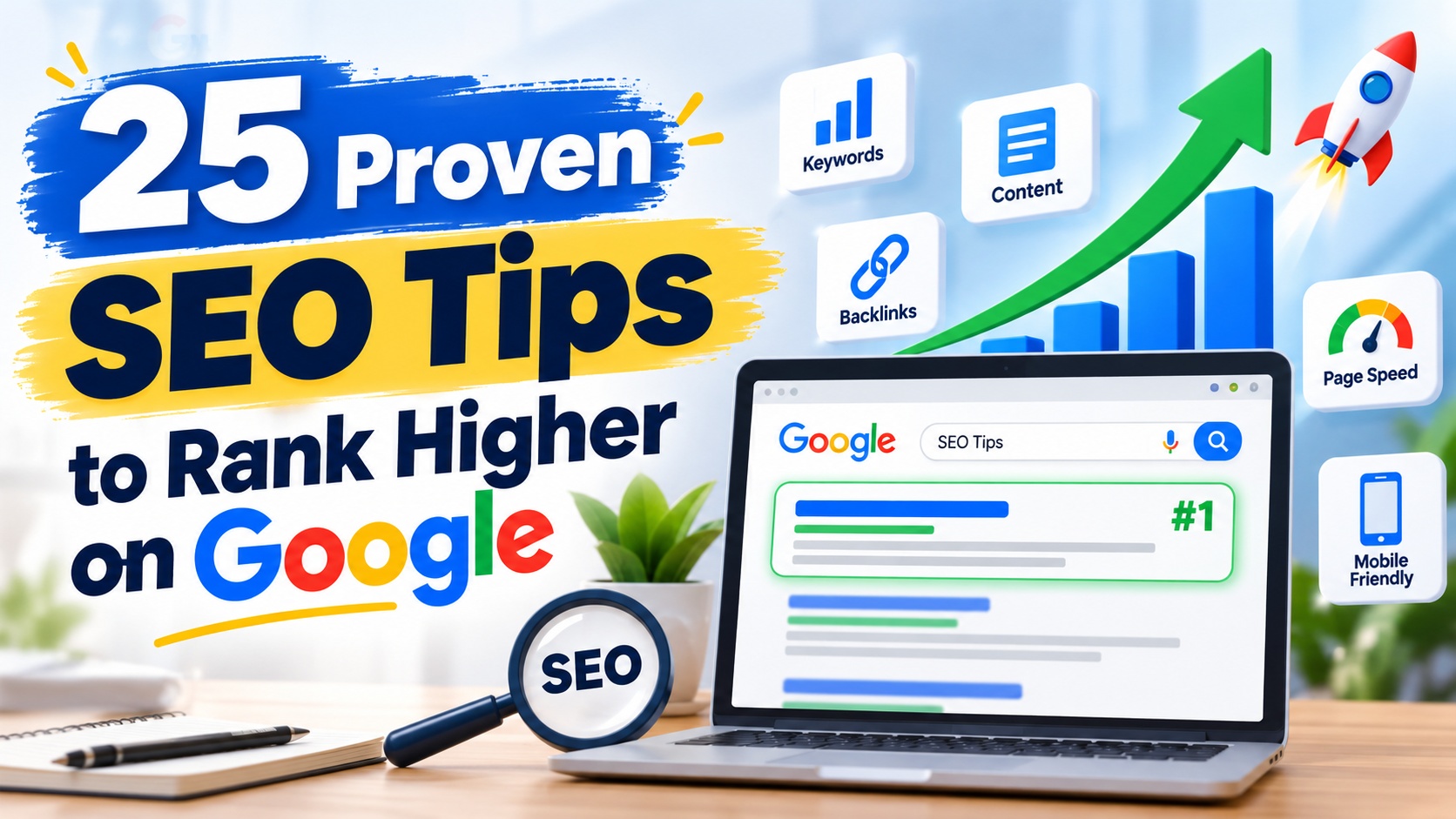
Better: 25 Proven SEO Tips to Rank Higher on Google
6. Create a Helpful Meta Description
A meta description provides a short summary of a page and may be used as part of the search result snippet.
Write a concise description that explains what users will learn and gives them a reason to visit the page. Include the main topic naturally, but avoid keyword stuffing or exaggerated promises.
Keep in mind that Google may sometimes generate a different snippet based on the user’s search.
7. Use a Clean and Descriptive URL
URLs should be easy to understand. Avoid unnecessarily long URLs containing dates, random numbers, or irrelevant words.
For this article, a clean URL could look like:
/seo-tips-to-rank-higher-on-google/
A descriptive URL helps users understand what they are about to visit and keeps your website structure easier to manage.
8. Structure Content with Proper Headings
Headings make long articles easier to scan and help organize information logically.
Use the main <h1> for the primary page heading, followed by <h2> headings for major sections and <h3> headings for subsections where appropriate.
Do not use headings simply to make text visually larger. Use them to create a meaningful content hierarchy.
9. Answer Important Questions Early
Visitors should not have to scroll through a long introduction before getting useful information.
If the page targets a specific question, provide a clear answer near the beginning and then expand on it. This improves usability and makes your content easier to understand.
10. Improve Content Depth Without Adding Fluff
Comprehensive content does not mean unnecessarily long content. Instead, cover the important aspects of a topic that a reader reasonably needs to know.
For an SEO article, that could include keyword research, search intent, on-page optimization, internal links, technical SEO, site performance, backlinks, content updates, and measurement.
Depth should come from usefulness, not repetition.
11. Add Internal Links Strategically
Internal links connect one page of your website to another. They help visitors discover related information and help search engines understand relationships between your pages.
For example, an article about SEO tips could naturally link to separate guides covering on-page SEO, technical SEO, keyword research, WordPress SEO, or website speed optimization.
Use descriptive anchor text rather than repeatedly using generic phrases such as “click here.”
12. Fix Broken Internal and External Links
Broken links create a poor experience and can make a website harder to maintain.
Periodically check important pages for links that lead to deleted pages, incorrect URLs, or unavailable resources. Update the destination when a better page exists or remove the link if it is no longer useful.
13. Optimize Images Properly
Large, unoptimized images can make pages unnecessarily slow. Resize images to appropriate dimensions and use efficient image formats where suitable.
Give important images descriptive filenames and provide meaningful alt text when the image conveys useful information. Alt text should describe the image rather than act as a place to stuff keywords.
14. Improve Page Loading Performance
Visitors expect websites to respond quickly. Heavy images, unnecessary scripts, excessive third-party code, poorly configured hosting, and bloated themes can all hurt performance.
Consider techniques such as image compression, browser caching, efficient code delivery, reducing unnecessary plugins, and using reliable hosting infrastructure.
Test important page templates rather than optimizing only your homepage.
15. Pay Attention to Core Web Vitals
Core Web Vitals are metrics designed to measure important aspects of real-world page experience, including loading performance, responsiveness, and visual stability.
Avoid layouts that suddenly shift while loading, oversized resources, and interactions that feel sluggish. Performance improvements should make the website genuinely better for visitors rather than simply chasing a test score.
16. Make Your Website Mobile-Friendly
A large portion of web browsing happens on mobile devices, so your pages should work properly across different screen sizes.
Check navigation menus, font sizes, buttons, forms, tables, images, advertisements, and other interactive elements on smartphones. Visitors should not need to zoom or struggle to tap small controls.
17. Use HTTPS
Your website should use HTTPS to protect information transferred between the visitor and your server.
Install a valid SSL/TLS certificate and make sure HTTP versions of your pages redirect correctly to HTTPS. Also check for mixed-content problems where an HTTPS page loads insecure resources.
18. Make Sure Google Can Crawl Important Pages
Excellent content cannot perform well in search if search engines cannot properly access it.
Check that important pages are not accidentally blocked through your robots.txt file or page-level directives. Pay particular attention after website redesigns, migrations, staging deployments, or major SEO plugin changes.
19. Create and Maintain an XML Sitemap
An XML sitemap gives search engines a structured list of URLs you want them to discover.
Most modern SEO plugins and content management systems can generate a sitemap automatically. Keep it updated and avoid filling it with unnecessary, duplicate, redirected, or intentionally non-indexable URLs.
20. Use Structured Data When Appropriate
Structured data provides machine-readable information about eligible page content.
Depending on your website, relevant structured data may describe articles, products, organizations, breadcrumbs, events, recipes, or other supported content types.
Only use structured data that accurately represents visible page content. Adding markup does not guarantee enhanced search-result features.
21. Build Backlinks Through Valuable Content
Links from other websites can help search engines discover content and understand its reputation and context. However, quality matters much more than collecting large numbers of low-value links.
Create resources that people have a genuine reason to reference. Original research, useful tools, detailed tutorials, statistics, templates, expert insights, and unique data can naturally attract links over time.
Avoid relying on manipulative link schemes designed solely to influence rankings.
22. Demonstrate Real Experience and Credibility
Generic content is increasingly easy to produce. One way to make your content more useful is to include information that comes from genuine experience or careful research.
When appropriate, explain what you tested, show original screenshots, provide examples, identify limitations, cite trustworthy sources, and clearly distinguish facts from opinions.
For topics involving money, health, safety, or other high-impact decisions, accuracy and trustworthy sourcing become especially important.
23. Update Older Content
Publishing new articles is not the only way to grow organic traffic. Existing pages can become outdated as products, software, statistics, interfaces, recommendations, and search behavior change.
Review important older pages periodically. Replace obsolete information, repair broken links, improve unclear explanations, add genuinely useful new sections, and remove information that no longer serves readers.
Do not change a publication date simply to make an unchanged article appear fresh.
24. Avoid Keyword Stuffing
Repeating the same keyword unnaturally throughout a page usually makes the content worse.
Use your primary topic naturally and write with normal language. Related terminology will often appear automatically when you explain a subject thoroughly.
Instead of worrying about a fixed keyword-density percentage, focus on whether every sentence is useful and sounds natural when read aloud.
25. Measure Results and Keep Improving
SEO is an ongoing process. Use reliable analytics and search-performance data to understand what is working.
Monitor useful indicators such as impressions, clicks, search queries, landing-page traffic, indexing issues, conversions, and engagement. Look beyond rankings alone—a page that attracts relevant visitors and generates meaningful actions can be more valuable than one ranking for an unrelated high-volume keyword.
When performance drops, investigate before making major changes. Rankings can fluctuate because of competition, seasonality, technical problems, content changes, search-system updates, or shifts in user demand.
Bonus SEO Tips for WordPress Websites
If you use WordPress, a few additional practices can make SEO management easier:
- Choose a lightweight and responsive WordPress theme.
- Use an established SEO plugin where it genuinely simplifies your workflow.
- Remove plugins you no longer need.
- Optimize uploaded images before serving unnecessarily large files.
- Use logical categories and avoid creating excessive thin archive pages.
- Keep WordPress core, themes, and plugins updated.
- Back up your website regularly before major technical changes.
- Use caching and performance optimization appropriately.
- Check important pages after theme or plugin updates.
Common SEO Mistakes to Avoid
Even a strong content strategy can be held back by basic SEO mistakes. Watch out for problems such as:
- Publishing copied, lightly rewritten, or low-value content.
- Writing exclusively for search engines instead of readers.
- Targeting keywords without understanding search intent.
- Using misleading titles that the page does not satisfy.
- Creating several pages that unnecessarily compete for the same purpose.
- Ignoring mobile usability and site performance.
- Buying low-quality links or participating in manipulative link schemes.
- Leaving important pages isolated without useful internal links.
- Allowing outdated articles to remain inaccurate.
- Expecting immediate rankings from a newly published page.
How Long Does SEO Take to Show Results?
There is no universal timeline for SEO results. A page may begin receiving impressions relatively quickly, while meaningful traffic growth can take considerably longer.
The timeline depends on factors such as your website’s history, competition, content quality, crawlability, existing visibility, backlinks, topic demand, and how effectively the page satisfies its intended audience.
Rather than expecting instant results, treat SEO as a long-term process of publishing useful resources, improving existing pages, maintaining technical quality, and learning from performance data.
Final Thoughts
Ranking higher on Google does not require chasing every new SEO trick. The strongest foundation is much simpler: understand what people are searching for, create genuinely helpful content, maintain a technically healthy website, provide a good user experience, and continuously improve your pages based on reliable data.
Start with the fundamentals. Improve search intent alignment, page titles, internal linking, content quality, mobile usability, site performance, crawlability, and outdated content before looking for shortcuts.
Most importantly, remember that SEO is not just about getting a visitor from Google. The real goal is to give that visitor a page worth visiting. When useful content and good SEO work together, your website has a much stronger foundation for sustainable organic growth.